 The stable fits neatly under the roof but when I saw it, I was rather disappointed to see the stable empty. Quite unusual for a Nativity Scene - no nativity…. I stood looking for a few minutes and then I spotted them, Joseph with staff in hand leading a donkey with a very pregnant Mary on top. Logical really, Jesus isn’t due for a few weeks yet. I have never found it odd that the baby Jesus was in the stable for the whole of advent, but obviously the builders of this Nativity Scene had found it odd and had put some thought into their rendition of a Nativity Scene.
To quote from Taizé’s website “It is a sign of the Season of Advent, into which Christians have just entered.
 The liturgy also underlines this time of waiting.. ” and this novel approach to what is usually seen as just a bit of extra festive “tinsel”, makes us think about the whole story and about the waiting. The quotation from Luke 2 on the wall reads “In those days Caesar Augustus issued a decree that a census should be taken of the entire Roman world. And everyone went to his own town to register.” Reading that and seeing Mary on her donkey did get me thinking.
The distance between Nazareth and Bethlehem is about 130 km as the crow flies, how long would that journey have taken them? Cees and I have been know to do quite a bit of walking and when in form we can clock up to a maximum of 25 km a day so if we were fit and in tip-top condition it would take us about 6 days on the flat.
 But we are talking about desert here and we are talking about an old man who is leading a donkey with his heavily pregnant wife on it. We should also not forget that to get to Bethlehem, they would have had to travel across Samaria which was hostile bandit country in those days. Some people even suggest that they would not have taken the shortest route but a longer safer route via modern day Jordan. So whilst the bible gives no figures (as far as I can see) it would have been a very long journey more than a couple of weeks, which might explain why they arrived so late in Bethlehem and missed out on all the available rooms.
In any case I will be following events as they unfurl between “Nazareth” and “Bethlehem” and let you know.
Our gites are not very near Bethlehem, but they are near Taizé and they have availability! La Tuilerie Website


 culminating with a Catholic Eucharist at four thirty. Four thirty must be the time they allocate to visiting groups as it was mid one Thursday afternoon last summer when the Archbishop of Canterbury was visiting that the Anglicans were allowed to hold their Eucharist.
 When Frère Roger first came to Taizé he worshipped alone in a room that he had dedicated for that purpose. When there were other Christians present they would join him in prayer, but as many of the people he was helping were in fact Jewish, he felt that it was totally inappropriate to make the prayer times communal. When he returned with some friends (later the first brothers) after the war with the purpose of setting up a community, they worshipped together in the original room but as the numbers of brothers and Christian visitors increased so did their need for a larger space. What is more logical than to use the small Romanesque church in Taizé, a holy place that had not been used for services for many years. But the Catholic church had other ideas about that. Despite not actually owning the building (all churches were seized during the Revolution and are now state owned) the Catholic church objected to having Protestants worshiping in their, albeit unused, church. An initial local agreement was swiftly rescinded and the request to use the church then went up through the bishop of Autun all the way to Paris where it ended up with Angelo Giuseppe Roncalli who was at that time the papal nuncio. He was a forward thinking man, he had also helped many Jews and other refugees during the war and maybe it was that common ground that helped convince him or maybe not, but he was the man who gave permission in 1948 for the brothers to have permanent non-rescindable use of the church for their daily prayers.
 Allowing Protestants to use the church was one thing, but allowing Catholics to join them was another. Despite securing an audience with Pope Pius XII, Frère Roger did not manage to get agreement for ecumenical worship out of him. A big step for a pope to take of course. Ten years passed and the pope died and a new one, Pope John XXIII, was elected. This new pope turned out to be none other than the Angelo Giuseppe Roncalli who had granted permission to use the church in Taizé and despite being old in years, he was still very young and forward thinking in his ways and it was he who supported the community of Taizé and led the way forward for allowing Catholics to take part in ecumenical worship. Maybe it was their common experiences during the war that drew these two men together, who knows, but whatever it was, he paved the way for the close links between the Vatican and the brotherhood that still exist today and it led to real reconciliation between differing Christian groups.
 Roger stayed helping Jews and Resistance fighters until the Nazis collapsed the Vichy government and occupied the whole of France. Roger then became a target himself and he was advised to leave. He returned after the war with some friends to set up a community dedicated to help those who had suffered during the war, particularly the young people. His sister joined him, to run the children’s house. Roger was a deeply religious young man as were his friends and their vision was to create an monastic order outside of any church. This order was founded officially on Easter day 1949.
 The service was held in the open in a meadow on the edge of Taizé with the buildings belonging to the community and the Romanesque church hung with icons. An area similar to the “garden” inside the community’s church was created for the monks to be together and the service began at a quarter to 8 by singing “The Lord is my Shepherd” in Filipino, courtesy of the Jesuit Music Ministry there. The service followed the usual lines of songs and silence but with Frère Alois also addressing the congregation of about 5,000 and telling them of Frère Roger, his life, his work and the influence he had had on the Christian movement throughout the world.
 Almost all of these visitors have mentioned the Silence Garden and the natural spring of St. Etienne and all have talked about how special it was.
 Dotted here and there on the grass and on the bridges were people sitting enjoying the silence, sleeping or reading. Just walking through the garden you get a real feeling of peace, people in groups talk at a whisper, but most people make no sound at all. This is in sharp contrast to the Frisbee games and general noise of the youngsters on top of the hill. I was dreading the hike back up the steep hill (244 steps I have been told), but actually it was not as daunting as I had feared and it certainly is a way to improve your fitness!
 In the Church of Reconciliation at Taizé there is a large pipe organ. I blogged about it last summer when it was installed, but I have come to learn so much more about it and its predecessors and yet now I seem to know so much less! By finding old photographs, I have seen that the organ in Taizé has changed a number of times over the years and it does beg the question why?
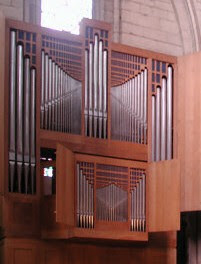 Interestingly, I have found information about what is possibly the second organ in Taizé. This organ was built specifically for the church in 1974 by Jürgen Ahrend a German organ builder, however, that had a very short life in the church because it was dismantled and put into storage in the Bressse in 1979. Via a monastery in Switzerland this organ eventually ended up in Lyon Cathedral in 1996, where it still is today. I suspect it was rather too loud for Taizé if it can be used in a cathedral!
 However, a friend of mine did find this photo in her collection, rather out of focus, but clearly an organ. Apparently this organ became “unreliable” due to the hot air heating system in the church and so it was removed when the church was refurbished in the winter of 2008/2009.
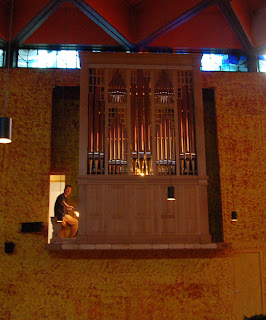 Also interestingly the organist sits sideways on to the church so that he does not have his back to the congregation. This must make it easier for the organist to still feel part of the community of singing.
